

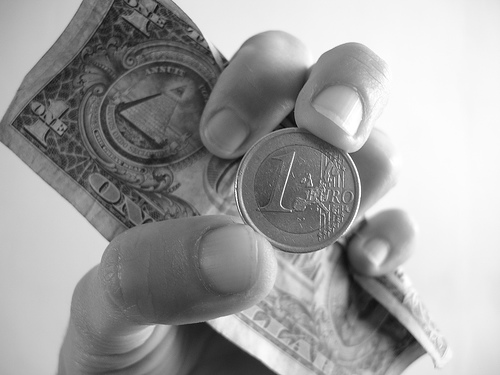
Your resolve is strong: despite the ever weakening U.S. dollar, you’re determined to see Europe no matter what it takes! Student loans, credit cards, maybe even selling candy bars door to door are ways to get the extra money, but how do you make it last once you’re there?
Vagabondish is reader-supported. When you buy through links on our site, we may earn a small affiliate commission. Read our disclosure.
Here are a few budget travel tips to stretch what funds you do have while not sacrificing any of the adventure.
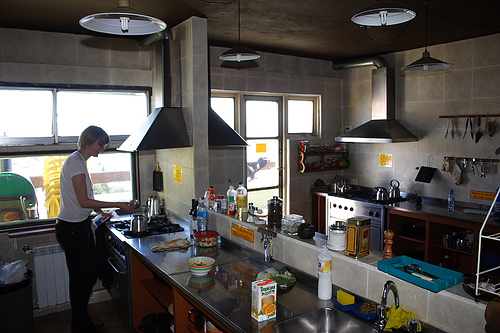
Hostel Kitchen, Patagonia © aokettun
#1: Cut the Cost of Food
Even eating at fast food chains like McDonald’s is no way to save money nowadays. A meal may look like the same cheap price as it is here in the States but that 5,50 on the menu in London is actually almost 11.00 US dollars (!). Forgo the Royal mit Kase in Germany or Mc Pesci in Italy and make your way to a local grocery store.
Surely you’ve heard it before: “buy your own groceries and save.” And it’s true. Even without a kitchen to cook in there are a variety of great on-the-road dishes you can whip up during a train ride or while sitting in the hostel lounge.
Of course the staples are meat, cheese and bread but a little imagination can do wonders. How about cold pizza? Foccacia, spaghetti sauce and salami covered in a slice of fresh mozzarella … all quite tasty and fun to make.
With the use of the hostel kitchen, your possibilities are endless. Pasta of course is super cheap but even a little ground meat and bread combined with packets of ketchup or mayo can make a good burger. Chances are there are tons of spices to add a little extra to your meal in the cupboard at the hostel. Travelers are notorious for leaving these things behind. Look and ask around as most of that pasta on the shelf has been there for 3 weeks when some kindhearted soul moved on and left it for someone just like you.
Shopping at the local grocery store is an adventure in itself. Eating local cuisine does not mean spending 15 Euro at a restaurant. Those items you’re looking at in the store are what locals eat at home. And those people you are shopping with? Well, they are the locals you’re traveling to engage.
Also, don’t forget about the on-the-go treats that the local store has sitting under the warmer. Many shops offer some sort of cheap, pre-cooked treat warming on a rack like you would see at a 7-Eleven back home. If you can keep your food costs to around $15US a day (about 10 Euros as of 2008) then your saving about $20-25US that you might have otherwise spent dining out.
#2: Get Off Your Arse!
Transportation in a city can really add up. Every Metro ride in Paris will cost you about 1.50 Euro for individual tickets and in Rome a three day Roma pass is about 25.00 Euro. All the while you are sitting on a crowded bus or – even worse – waiting for the subway to arrive underground, far from the sights, sounds and people above that you came to experience. An even more persuasive argument: you are much more likely to get pickpocketed on that bus than strolling down a city street.
Why not pull out your guidebook map, plot a path to your destination and walk? There simply is no need to take public transportation from one sight to another each and every time. Chances are that your points of interest are not all that far from each other anyways. Walking also allows you to stroll the streets, seeing things that the lazy and rich miss out on as they zip along a hundred feet underground.
Sure you’re probably going to have to take the metro or bus sometimes – getting from the airport to your hotel for example or that long journey home after an exhausting day of walking. But think of it as a treat for all your hard work, rather than a means to get where you can otherwise walk.
If you must use public transportation try to figure out how much you will be using. Usually you can buy books of metro or bus tickets, possibly even day tickets, for much cheaper than one-way individual tickets. Check out the ticket windows at the station and you will likely see a run down of available ticket options. Choose the one closest to your essential needs and save a bit by purchasing in bulk.
If you end up with extra or are not going to use your whole day pass, pass it on to a fellow traveler. Surely there’s a fellow cost-conscious traveler staying at your ho(s)tel (you both likely chose it because it was inexpensive) who would love to use your leftover tickets.
Fist Full of Dollar (and a Euro) © ganessas
#3: Being Flexible Pays Dividends
Putting in for a vacation at work and then trying to find the cheapest airline tickets for your days off is never the best strategy when trying to save. Being flexible with your travel dates can save hundreds of dollars.
Just being able to leave on a Tuesday or Wednesday can save you tons of money on roundtrip airfare. Not convincing yourself that summer is the only time to see Europe for good weather can also be very rewarding. Sure the weather might be a bit colder in November or early December but that just means bring a heavier jacket and you can experience a beautiful German town covered in snow.
A quick search on Kayak.com shows that flying out of New York on August 1st and returning August 10th from Paris will cost you $914US this year. Move that same 10-day trip up to early November – the 7th and the 16th – and you’ll be paying $582US. That’s a savings of $332US!
You can also be flexible in where you’re going. If it’s just for fun then I would argue it doesn’t matter where you go in Europe. But let’s say you just have to see Rome on August 1st through the 10th, why not think about flying into London rather than a direct flight? A search like the one above on the day this was written shows direct flights for $1157. Flying into London however, and then taking a budget airline flight to Rome ends up saving $142. That extra money is something that can be used for a nice hotel stay, a couple of fancy dinners or that heavier jacket so you can go next November and save even more.
#4: Go Where Fewer Men Have Gone Before
Many European travelers head to Rome, Paris and Barcelona – three of the most expensive cities to visit. Why not head off the beaten path and experience Eastern Europe instead? Year-round prices are substantially cheaper and crowds are thinner.
Searching Kayak.com for a single hotel room on November 4th, 2008 in Rome shows that a 3-star hotel 1.1 miles from the city center is $91.00. Taking that same date and searching for 3-star hotels in Krakow Poland results in accommodation for $63.00 only .6 miles from the city center and $51.00 a mere 1.8 miles from the center.
The savings obviously don’t stop there. Restaurant prices will be lower as cities in Eastern Europe are not the tourist traps that their western counterparts are. Beer and wine tend to cost a lot less, making those late nights at the local pub much cheaper too.
With several Eastern European countries in slow transition to the Euro, American travelers still have a bit of an edge on the exchange rate. At the time this article was written .62 US cents still gets you 1 Czech Koruny (dollar) and about .45 cents gets you 1 Polish Zlotych. Compare this to the almost $1.60 a Euro will cost you or the very expensive $2 a British pound is going to set you back. On top of all this, you avoid the dense crowds that flock to more traditional European destinations.
#5: Europe is a Museum You Already Paid for
I like to be able to say that I’ve seen the Mona Lisa or Michelangelo’s David but truthfully to me, neither was worth the cost. The Mona Lisa is disappointingly small at only 31 x 21 inches and entrance to the Louvre is about 9 Euro. That’s not to say that 9 Euro is not a fair price for all the wonderful art one can see but I’m just trying to make a point.
For the average person, the Mona Lisa – likely the first thing you head to in the Louvre – is a disappointment.
The David statue which is housed in the Accademia in Florence costs 6.50 Euro and without reservations can mean a long wait in line. Compare that to heading up the street to Piazza della Signoria where an exact replica of the statue stands in the same spot that the original stood for over 300 years which you can see for free.
Before the hate letters start rolling in from art lovers around the world understand I am only making suggestions on how to save money. By all means allow yourself the cash to see one or two exhibits that are important to you. Not paying for each and every museum or sight is just one way to cut the costs of your trip.
If you just have to see a particular museum or work of art, look for freebies. Most museums have one free day a month and/or offer discounts to students and youths. There are more than enough free things to do in Europe and many can be just as satisfying as those with an attendant price tag.
European cities are themselves works of art. Stroll the streets and admire the wonderful architecture of Paris or the cobbled streets of Ulm. Find a well maintained, beautiful park in London and people watch or pull up a section of stair on San Marco Square in Venice and enjoy a bottle of wine until the lamps light up at dusk. Head out on the pier in Barcelona and listen to the waves or watch the fishing boats head drift into the night from the coast of Cinque Terre Italy … (all with a bottle of wine if you ask me).
Seeing Europe does not have to mean paying admission. Think of your airline ticket, hotel and food costs alone as admission to the wonderful and amazing cities that locals experience everyday.