


You finally allow yourself to stop for a lunch break after hiking since dawn. The sun shines brightly, and you squint to see the vast and beautiful scenery unfolding before you. Although you are inspired by what you see, you are also dead tired. And now that you’ve stopped, the aches and pains are beginning to take hold.
Vagabondish is reader-supported. When you buy through links on our site, we may earn a small affiliate commission. Read our disclosure.
But there is no time to coddle your wounds; you stand up with all your might and continue on for a further few hours in the dead heat.
Why, oh why on earth you ask, would you subject yourself to such punishment? Just ask anybody who has completed the 800 kilometer Camino de Santiago de Compostela, and they’ll probably have many compelling reasons for you.
Amanda said it beautifully in this article, when she highlighted the benefits of really slow travel. Seeing your surroundings and taking in a new place is best done on foot, where you can really take the time to absorb the culture, sounds, smells and pulse of a place.
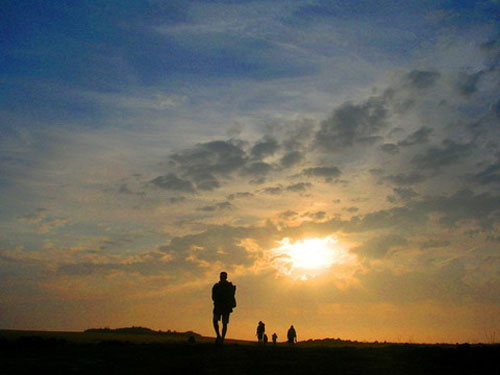
© alessandro pucci
Taking this advice to new heights, a really slow trip that will make for an epic adventure is the Camino de Santiago de Compostela: an 800km pilgrimage over the Pyrenees mountains in France and through to the town of Santiago de Compostela in north-western Spain.
The trip is meant to follow the footsteps of the Apostle St. James, who made the journey himself with nothing more than the clothes on his back. He preached Christianity in Spain, and eventually was martyred for his actions. After being put to death in Judea, his body was miraculously transported back to Compostela, where he was (and still is) buried and revered.
Variations of this pilgrimage have been followed ever since, and especially in the Middle Ages, Santiago de Compostela was considered to be the most famous destination in the world for pilgrims.
But as with all spiritual texts, much is left to interpretation. In fact, many of those who walk the Camino today don’t even do it for religious reasons. The largest demographic of pilgrims that come to Santiago de Compostela now are Japanese Buddhists.
The most popular route is the Camino Frances, following the 780km trip outlined above by starting in St Jean Pied de Port in France. However there are routes all over Europe, and pilgrims walk all or any part of the trip they choose. The common denominator of all pilgrimages is the destination: Santiago de Compostela.
Why Be A Pilgrim?
When you undertake a mission as large as an 800km hike, you can’t exactly carry everything you need on your back. So in the tradition of being a pilgrim, you rely on the hospitality of people along the way to help you. Along the (relatively) well-marked route, registered monasteries, hostels, and eateries will host pilgrims for fees little (if any) more than their actual costs. It is a humbling experience, and for some people, learning to accept the kindness of others can lead to wonderful growth.
Many travelers do the pilgrimage over a period of approximately 30-60 days, which translates to about 15-30kms/day of walking. The 30-day pilgrims are truly hard core (this coming from a hiker/mountaineer myself), as I would choose to complete the journey in 60-90 days myself, taking some time to enjoy the scenery around me. Alas, not everyone has that much time available to complete the journey.
Either way, with all that walking, there’s sure to be a lot of time for silent reflection and possibly an epiphany or two. To this end, many people prefer to do the pilgrimage solo, and will even take a vow of silence during the time they walk. Others yet travel with friends or family, or make fast friends with other travelers on the road, and will choose to walk together for large chunks of the trip.
By the end of the day though, whether you walked alone or in company, you walked a heck of a long way and will find yourself physically and mentally challenged to wake up the next morning and continue. You are encouraged by your supportive hosts, as well as your fellow travelers, and in the spirit of camaraderie you continue on a journey that you might otherwise abandon due to its almost incomprehensible grandeur.
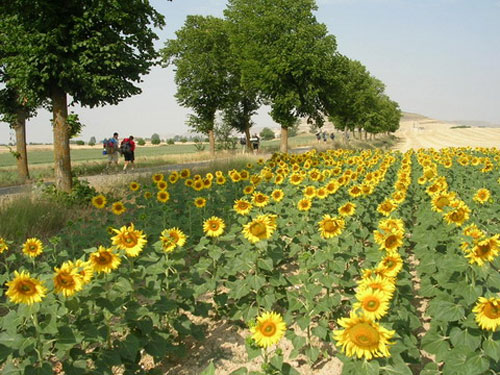
© alessandro pucci
What to Expect
Accommodations:
The accommodations vary in nature, but in general are rarely anything fancy. The traditional refuges are often in monasteries or humble homes, and operate on a first-come, first-served basis, giving preference to walkers. Some people choose to ride bicycles, and others yet drive cars. Almost no respect or preference is afforded to those who drive, and the bicyclists tend to fall in a middle ground — some vehemently object to the use of any vehicles, even pedal powered ones.
Expect traditional refuges to be dormitory-style rooms, and functioning showers are occasional treats along the way. Hot showers are even rarer.
Having said that, there are a growing number of hostels designed for the increasing number of pilgrims, so if you are prepared to pay for it, you could receive a private room and maybe even an ensuite bathroom.
Landscape:
Depending on the time of year and the specific route chosen, you will encounter everything from snowy alpine climates to dry hot landscapes. Some parts of the pilgrimage take you alongside busy highways and roads with little romance (and sometimes a rather dangerous path), and other parts wind through vast fields and quaint towns.
Navigation:
The route itself is marked with yellow scallop shells, usually posted on granite markers, but sometimes just painted on the sides of buildings or fence posts. Many a pilgrim has lost their way due to missing markers or well-camouflaged ones at that. I have yet to read a pilgrim’s story where they didn’t deviate off-course at least once during their journey. Apparently that’s part of the challenge and the fun; nearing the end of a tiring day to realize that you overshot your destination and either have to turn back and walk an hour, or keep on for an additional two hours to reach the next checkpoint.
Blisters:
Expect lots and lots of blisters on your tender tootsies. Even with proper training and a well broken-in pair of hiking boots, your feet will hurt. And hurt. And hurt. This too, is part of the challenge of the pilgrimage and what sets pilgrims apart.
Recognition:
Some pilgrims go “all out” by wearing the typical cloak, scallop necklace, and carrying a staff to identify themselves as pilgrims. Others find this too “touristy” and prefer to travel on the more incognito side.
But to the natives of small towns who have seen pilgrims pass by their doorsteps for decades (even centuries), there is a level of recognition that passes over their face, and cheerful waves and smiles are common and welcome signs of encouragement for the weary pilgrim.
Camino de Santiago de Compostela Passport © caminosantiagocompostela.com
Passports:
No, we’re not talking about your international passport. You can pick up a “Compostela passport” at any major city along the pilgrim route, which you get stamped by your various hosts and checkpoints along the way. When you reach Santiago de Compostela with your stamped passport, you can receive an official “Compostela” or “Certificado”, proving and certifying your completed pilgrimage.
Afterwards:
As you can imagine, the Camino de Santiago de Compostela is an epic journey full of high and low emotional points, intense friendships, and moments of clarity amidst the struggle of the trip.
But what happens afterwards? A service is performed in honor of the pilgrims at the big cathedral in Santiago de Compostela, and then … everybody just parts ways. Some people continue on to Camino de Finisterre which was considered to be the “end of the world” in Medieval times and in some circles is thought to be the true end of the pilgrimage.
Ultimately in every pilgrim’s story is a hint of letdown or anticlimactic feelings at the end. Fellow travelers who were your “best friends” during the trip suddenly become strangers, as you find yourself unable to carry on a conversation without the tie that binds (being the trip).
You return to your “regular life”, and struggle to re-integrate yourself into your previous daily routine. Some people manage to after a short while, whilst others make drastic life changes as a result of their months of walking and quiet reflection. Many a book has been written about just this.
But then again, don’t these challenges ring true for every traveler? After exploring a new place, a new culture, and a new side of yourself, it’s always hard to return home without being a changed person. The Camino de Santiago de Compostela is yet another way for us travelers to redefine ourselves by pushing our limits, challenging our beliefs, and learning a lot about ourselves along the way.
Here are some links to get you started on your own Camino: