
FEATURE //
How to Learn a New Language 1 Week Before Your Trip
by Amanda Kendle
Speaking a bit of the local language is a skill that will improve your travel experience immeasurably. The problem is that learning languages is really, really difficult, even when you have plenty of time. Here are my tips on taking a crash course in the basics of a language when your departure date looms very near. You just need ten or fifteen minutes a day to give yourself a bit of an advantage in the traveling stakes.
7 Days to Go: Research
This might sound dumb, but look into exactly what language they speak in the country you’re visiting. I had friends working in Chile who were more than a little surprised that their Spanish-from-Spain was sometimes not understood and at other times led to hilarious misunderstandings.
Hit the internet to find out which language or dialect is going to work for you best. Even if all you learn is that the locals at your destination speak a dictionary-less version of the language, you’ll be wiser. I wish I’d known before I moved to Baden-Württemberg in south-west Germany that the locals would speak to me in Swabian. At the time I just thought that the six years of German study I’d done had all been a big failure.
6 Days to Go: Equip
You need resources. Exactly what depends on how long your trip is, but for anything more than a few days I strongly recommend a good phrase book. My personal preference is for Lonely Planet Phrasebooks, simply because they’re the right size and weight, include some interesting cultural asides and most importantly, focus on the kinds of sentences you really want to use. Unlike guidebooks, phrasebooks don’t go out of date fast so pick up a second-hand one if you’re keen.
You can also return to the internet and search for some pages of useful phrases that a helpful traveler or native speaker has already prepared for you. Print these off ready for your assault on the new language. Or look for a podcast that gives you a couple of beginner level lessons.
5 Days to Go: Cram
Even if you can procrastinate as well as me, you have to admit that five days before take-off is really the latest that you can start trying to learn a few words and have any hope of being able to use them. Start with four or five key phrases, including “thank you” and “excuse me” and a couple of your own choice, like greetings or questions about taxis and toilets.
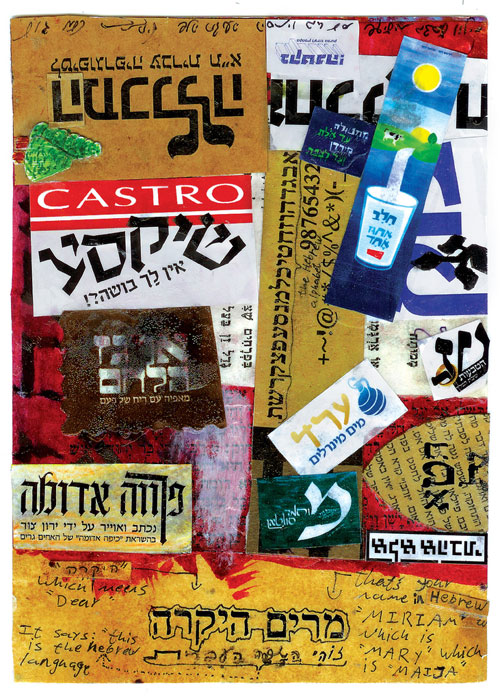
If you’re heading to a country that doesn’t use the Roman alphabet, you should also try to learn to recognize the language. Learning the Cyrillic alphabet before you go to Russia is a manageable task, for example, and very useful when it comes to reading street signs. Making a start on Japanese katakana – the symbols they use when writing foreign words – is also doable, and a great help if you want to order some food in Japan. Break up the alphabets into five chunks and work on memorizing a chunk per day.
4 Days to Go: Panic
So you’ve forgotten everything you learned yesterday. Don’t worry, that’s normal, and it’s not really that it’s forgotten, you just can’t find it in your brain. Learn everything again and by take-off day you’ll remember. Stick phrases in places you’ll be forced to constantly see them – on your cell phone, in the bathroom, around your computer screen.
If you’ve picked up a phrasebook, flick through regularly to become familiar with its layout. It’s no use knowing that there’s a page to help you order a not-so-spicy meal in a restaurant if you can’t find it before the waiter gets impatient and walks off.
3 Days to Go: Add
Your handful of phrases will be starting to sound familiar now. It’s time to expand your vocabulary. On your travels, forming grammatically perfect sentences is unimportant. Knowing a few key words, however, is essential. Pick a few words that will be useful to you and memorize them. Things like “battery” if you’re a tech freak, “film” if you still can’t accept that digital cameras might take photos as well as the old way, “vegetarian” if you don’t eat meat. Write them out a hundred times, stick them on the fridge or tattoo them on your wrist.
2 Days to Go: Practice
You’re probably getting sick of your five phrases by now. If you can remember them all without looking at your notes, then add a couple more. If not, keep practicing. It might not be as easy to learn these sentences as it would have been in your elementary school days but you will remember them.
1 Day to Go: Impress
With a few basics under your belt, it’s time to get the pièce de résistance. That’s the word or sentence that will stun the locals you meet and have them making friends with you for life. My husband’s favorite when we visited France was perceuse, which means a drill, like the kind you use to fix something to a wall. He’d learned it off a fellow engineer who’d spent time in Paris and it forever stuck in his mind, and you’d be amazed how many French men you can impress with a word like this in just one weekend. (French women, on the other hand, were as non-plussed as I was).
Take-Off Day: Speak
Use some of your flight or travel time to revise the bits of language you’ve been picking up over the last week. When you get into the country, speak. Say hello in the local language, thank everybody who helps you in their own language, and don’t be afraid to try out your new phrases. The chances are good that locals will respond positively and might even teach a new phrase or two. Most likely how to swear, but that’s the normal progression of language learning.
If you liked this post, subscribe to our full feed RSS. You can also subscribe by email and have new posts delivered directly to your inbox daily.
About the Author
Amanda Kendle is an Australian travel addict, writer and English teacher who's visited more than thirty countries. As well as regular blogging jobs including Jaunted, HotelChatter and Vagabondish, she writes magazine articles and is working on her first novel. She can be reached at her personal blog - Not A Ballerina.


November 15th, 2007
These ideas are great for those of us that leave everything to the last minute – especially daunting things like getting your head around another language.
Also, the power of immersion is pretty amazing, especially if (like you say) you’re willing to give it a go and try out your new-found language on the locals.
I’ve found that most people respond far better to someone who is giving the language a go (however miserably you might be failing) than to someone who just keeps repeating phrases in English louder and louder in the hope that it will make them understood!
November 16th, 2007
I completely agree, Tara. The first time I fumbled my way through a French sentence in Quebec, I could see the shop owner’s face light up.
I butchered what I was trying to say, but he appreciated the effort all the same.
November 21st, 2007
I totally agree. There was a long, loud argument on Lonely Planet’s Thorntree forum recently about whether people really do appreciate someone having learned just a few words or if it’s just a waste of time – some people were adamant that it was almost insulting to learn 3 words of Thai and use them – but I’m sure the majority of people are happier to hear a couple of butchered phrases that show you do care that their language and/or culture is different.
November 23rd, 2007
Amanda, the LP-forum idea that someone in a foreign country would want me speaking English (when they don’t understand it) to them rather than their own native tongue is ludicrous in my opinion.
We have a large Spanish speaking population here in the States and I would much rather be spoken to in broken English than fluent Spanish.
January 12th, 2008
When we were in Moscow last month, we did find that the locals appreciated that we at least tried to use some of their language. And as a result, they seemed more tolerant of us when we did have to revert back to English.
February 4th, 2008
[...] a little advanced planning, and an introduction to the basics, it can be surprisingly easy to pick up a language on the [...]
February 12th, 2008
Great article. A good reminder that its never too late to start learning.
February 17th, 2008
[...] a little advanced planning, http://www.vagabondish.com/how.....e-trip/and an introduction to the [...]
June 25th, 2008
I don’t really like Lonely Planet phrasebooks and I found them extremely difficult to use, they were designed more as “travel dialogue textbook” instead, but how are you supposed to find the right words in front of the bemused listeners?
The last Lonely Planet phrasebook I used was the Vietnamese one, I spent some time to find the word “spoon” in the “dictionary” section which I could not find, then I spent some more time in the “Eating Out” section and still couldn’t find the right word.
Then I bought the Rough Guide Vietnamese phrasebook/dictionary: http://snipr.com/2ozo2
The book was extremely useful and probably the first dictionary-cum-phrasebook for all Vietnamese learners (or just travellers in Vietnam) who can read English. A comprehensive English-Vietnamese word list covers all common words used in daily conversation, in some words simple dialogues are provided. The Vietnamese-English section is rather weak.
This book is not as popular as the Lonely Planet phrasebook which is really a pity because it’s much better. Whenever I met some other travellers using the LP phrasebook (Vietnamese) I showed them this one of mine, all of them were impressed and hoped to buy this instead!
July 3rd, 2008
[...] a little advanced planning, and an introduction to the basics, it can be surprisingly easy to pick up a language on the [...]
November 14th, 2008
I just find learning the key phrases gets me by
Where is *blank*
Where is the bathroom?
Help
How do I get to
Hello
Please
Thank you
Excuse me
The last 4 go a long way.
November 24th, 2008
Amanda,
This is a great post…I’m glad it was reposted because I didn’t know about Vagabondish at that time. Now, of course, I am addicted!!
Here at Fundacion Arte del Mundo we are expanding our language school (Idiomas del Mundo)to include many languages. We are concentrating our efforts in conversational language for the traveler and local people here in Banos,Tungurahua, Ecuador which survives on eco and adventure tourism.
The more I teach (and travel) the more convinced I am that communication is the key to a good experience. Much can be done without words, but it surely helps to have a few necessary phrases in your head and people do appreciate it!
November 24th, 2008
Hi Amanda, I really liked your tips, very clever! and of course absolutely useful.
Zuri
November 24th, 2008
Thanks Jody, glad you liked it.
I agree – being able to communicate definitely makes for a better travel experience. You don’t have to be fluent but just the effort of trying to use the local language makes a big difference.
May 6th, 2010
Great article! I’m linking it to my facebook.
I would add one more phrase to the top-5, right up there with please and thank you, and probably more helpful than hello: “I’m sorry.” The number of times I need to say “I’m sorry” when I’m traveling is phenomenal– whether apologizing for just smacking some poor commuter with my backpack, or for my lack of comprehension about what I’ve just ordered, it’s the one phrase that goes further than any other in turning an irritated glare into a compassionate smile.
August 18th, 2010
[...] additional language-related articles: 10 Steps to Becoming Fluent in a Language in 6 months or Less How to Learn a New Language 1 Week Before Your Trip How to Resurrect Your High School Spanish…or Any Language (another Tim Ferriss piece) 20+ [...]