
Reserve JFK Parking, SeaTac and Orlando Airport Parking

The Peace of Negele Borena, Ethiopia

by

Yesterday morning I had three breakfasts. One, a cup of sweet, spiced tea at a restaurant with interwoven branches for a ceiling, colored umbrellas mounted on the walls, and birds chirping overhead. Two, more tea and spicy scrambled eggs, served under the faded awnings of a once-luxurious hotel.

Three was a cup of coffee from an unmarked shop that’s supposedly the best in town, where my companions and I sat on rough dirt benches below street level. As dueling chants rang through the air—the local church and mosque competing for the attention of the faithful—a shawl-wrapped elderly woman handed us each a tiny, clouded cup.
Ethiopia
© Eva-Lotta Jansson / Oxfam America

It was a typical morning in Negele Borena (or just Negele, as my hosts call it), the town in southeastern Ethiopia where we’ve been staying for the last few days. I don’t usually eat multiple breakfasts, of course—or take two hours to get geared up for work in the morning—but the pace of life here is a little different from what I’m used to.

I’m in Negele with a group of colleagues to document the work of the Liben Pastoralist Development Association (LPDA), a local NGO that’s funded by our international organization Oxfam America. LPDA focuses on helping the region’s traditionally rural, semi-nomadic people—the Borena for whom the town is named—cope with the persistent drought that’s been spreading across East Africa.

Though LPDA’s work is fascinating, it’s Negele itself that haunts me the most: a frontier town without a frontier, a Wild West kind of place that I never knew existed.
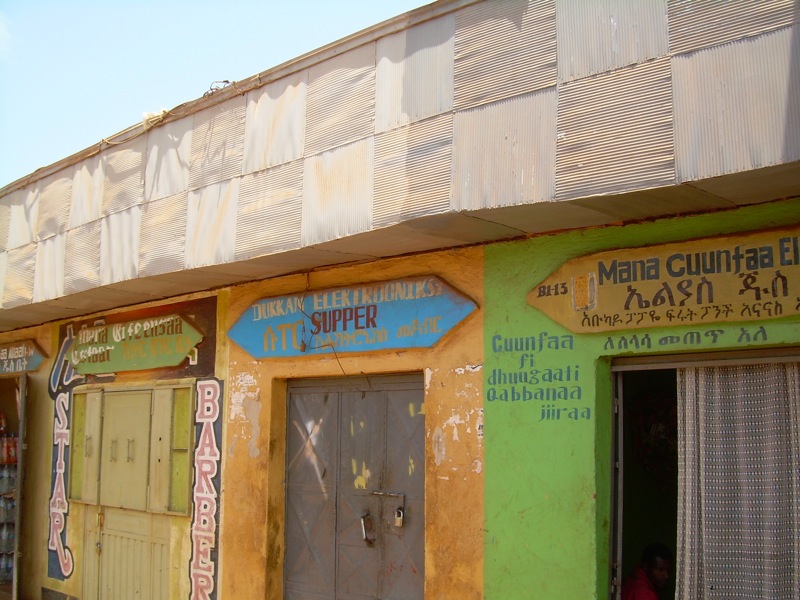
Shopfronts of Negelle Borena, Ethiopia
Shopfronts of Negelle Borena © Anna Kramer

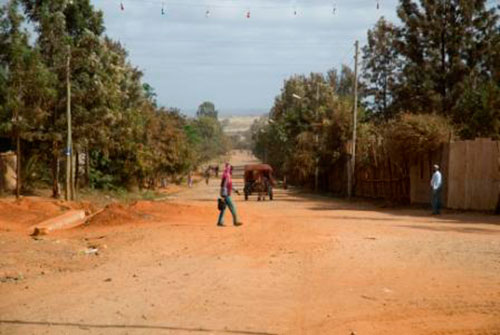
Here, there are hardly any cars, no tall buildings. The land and buildings seem comfortably faded, all hard edges softened by time and wind. Trash blows through the streets, and packs of wild dogs fill the night with their howls. The dirt roads are rutted with ditches and holes that pose a hazard when the electricity goes off most nights at 10pm.

We may have eaten three breakfasts this morning, but the other night we stumbled exhausted into one of those same restaurants, only to find that they didn’t have any food left (or even beer, which would have helped somewhat). Just Fanta and Mirinda, a sticky-sweet orange soda, warm. Did we want some?

I’ve never seen a restaurant run out of food before. I’ve never seen a whole town run out of water, either. But Negele did in February 2008, when the pond that serves as the town’s water source dried up; for a month, residents had running water only once every 10 days. Even now, the drought continues: Though heavy clouds mass overhead most afternoons, it hasn’t rained here in months.

Because of the drought, scarcity—of water, of electricity, of food—is a fact of life for people here. Things I take for granted at home (hot showers, internet access, bottles of water) require careful planning and negotiation. Water doesn’t always come out of the tap, and lights don’t always turn on.
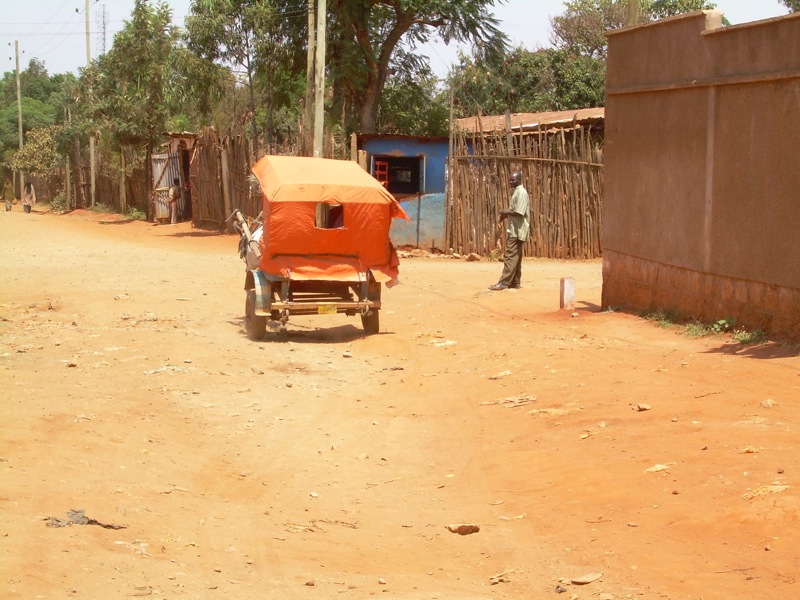
Horse-Drawn Taxi (gari) in Negelle Borena, Ethiopia
Horse-Drawn Taxi (gari) in Negelle © Anna Kramer

But “Negele Borena” also means “the peace of the Borena”—and it does feel peaceful here, soothing even. Each morning I wake up to the soft jingling of the gari, horse-drawn carts with tattered orange awnings that serve as the town’s taxis. Sunrise and sunset unfold slowly, each shift in color noticeable: pale green, gold, translucent rose, and a deep, lingering blue that I’ve never seen anywhere but Ethiopia. The fine, dry, clean, red dust floats through the air, working its way into the folds of my clothes, clinging to my skin; the air smells of smoke, like the tang of distant campfires. Outside of town the buildings quickly give way to scattered huts and fields of pale gold teff, the one main road carving its way east all the way to Mogadishu.

And once the power goes off, the streets become mysterious and pitch-black, the footing uneven under a sky crammed with billions of stars.

Last night a colleague and I ventured out to a ragged-looking bar lit only by a single, guttering candle, where we were lucky to get the last few St. George beers—cold ones, even. We sat outside on the street in wobbly plastic chairs, hearing the soft thump and wail of traditional Oromo music echoing down the street from the one bar in town with a generator. Now and then a truck drove by, moving slowly on the dark streets, the cough of its motor very loud in the stillness. Despite the dark, the people passing by still stopped to talk together, angling their flashlights upward to illuminate one another’s faces.

Watching them, I realized that life here doesn’t stop, even when resources are scarce.

Spending time in Negele makes me question what I need in life versus what I want. Perched on this chair, staring up at the unfamiliar constellations, a lot of the things I thought I couldn’t live without seem less than important.

I never wanted to leave. But after a long time, I made my way back to my hotel, just another light flickering through the shadows.

Planning a trip? Be sure to check out these B&B's in Ethiopia, Africa.

If you liked this post, subscribe to our full feed RSS. You can also subscribe by email and have new posts delivered directly to your inbox daily.

You Might Also Like

About the Author


Anna Kramer is a writer and blogger for the international NGO Oxfam America, as well as an occasional music blogger and an avid traveler. She currently lives in Boston.

Share Your Thoughts

[...] This post was mentioned on Twitter by Anna Kramer and kevin chan. kevin chan said: rt @vagabondish The Peace of Negele Borena, Ethiopia http://tinyurl.com/y9ju6hu #travel [...]

Jatani Huka
October 13th, 2009

The writing by Anna Karmer intigteled The peace of Nagelle Borana was realy intresting and very expressive of the life that even we the dwelers of the City of peace did not notice Anna since it was so intresting I have even forwarded it to the mayor of the city.

Cheeeeeeers;with St.george beer.
Jatani(LPDA)

Falmata Nuri
October 19th, 2009

Great! What was narrated above by Anna Karmer is the reality of many rural towns in Oromia, especially in drier and semi-drier parts where there is water shortage. The effort of development practioners is to bring about bettement of the lives of the community by engaging all stakeholders including the government which has more capacity and power.

tgpina
November 18th, 2009

wow i love it all except some …means the narration in almost right but, in all cases like for z drought, water pb bla bla is not only the pb of govt also the NGO’s means Donors r highly responsible because always they forget their aim except in rare case, so please who knows one days borena became… so that please let stand for the development of borena “the peace of borena” i am the one who r ready to fight with this drought and all our problem and please (donors) now a days,may b oxfam…

Tad
December 4th, 2009

This is amazing; I was born in Negele until my late teen age. Everything you wrote tells just what I remember from the time I was growing up and I am disappointed that it has stayed the same way or got worse for so many years. I have still a great emotionally attachment to Negele and I dearly miss it. I don’t know what could be done to make the life in the town and that region get better. I guess this could be a good discussion point.

mussa hussen
February 17th, 2010

The authour(anna kamer)rememembered me of the book THE CARPET WAR(by christopher kramer) that once i had read when i was in campus,and her insightful wrighting about my PeaceFUL town NEGGELLE BORENA resembeled her with the former. ilove negelle,GOD BLESS NEGELLE,AND THANKS TO THE AUTHOR.

Adisho
August 27th, 2010

2 year before i am in Nagelle Borena where i born now i am in Grand Rapid Michigan in USA i love mi Nagelle Borena. Especially Lagabora east of town and Gumi Gayo Elementary school south west of town near qotoba or 43(arbasostanya Kiflator). i live 01 kebele after Nagelle borena Hospital next Nagade Mosque Gari Safari every body know me with Adisho but real name is Adan and i like Nagelle Borena.

tgpina
August 30th, 2010

hey adisho i cant remeber u i was born Negelle Borena too…anyways try to join on facebook Voice of negelle borena page…thanx

Adisho
October 18th, 2010

i am Adan but youth of mi country called me with this name Adisho.i born in Negelle Borena in 1993. i went Gada Primary and Gumi Gayo junior school, after that i went to high school and went up to University of business In Negelle Borena. i live 01 Kabele next mosque that Nagade built, if u live near General Hospital of Negelle, u will go down to Garri safari and ask me. with this name Adisho. i am famous in Garri safari every body know me. i am In Grand Rapids,Michigan USA. Email: nuraadam52@yahoo.com thanks u

Adisho
October 18th, 2010

yea i bor in Negelle Borena what is ur facebook
this is mi Email : nuraadam52@yahoo.com
u can send ur facebook with that email and we will communicate a bout Negelle borena. I am in Grand rapids Michigan USA
please i like to communicate to negelle people really i miss them. thxs
my face book: Adams Robert
location : Grand Rapids
school : Union high school

Adisho
November 12th, 2010

i pass many problem , but know i am cool.i thank God every time. Negele Is my Home and i never forget in my life the way we play in red sand,the way we go to school in mud when it is rainy season.i miss my mum , and my little sisters and brothers, and friends too. I change my country to USA the life here is different from my homeland, everything with technology but i don’t like either. English proverb said” East and West Home is the Best”. my Email: nuraadam52@yahoo.com
For all Ethiopian citizen only . i thank Negele resdence

Gashaw Getachew Gobena
November 17th, 2010

I would like to thank the author who brought the lives of our town in to picture.

mimi
December 30th, 2010

Great work author! U remined me of my city, I grew up in nagelle borena. Everything u wrote is very true. I miss nagelle very much! I can’t wait to visit!
Thank u for posting!!

Gashaw Getachew
January 9th, 2011

there would be no sufficient water ,electricity ,and other facilities ,but it does not matter for me. In what ever situation I would like to be there(borena) .thanks to GOD I am still there and I never find lovely place than borena(and borenean)

Adisho
February 19th, 2011

hey mens how is Negelle Borena. i heard people talking bad about Borena so i didnt like it i just left Negelle few year ago but i didnt heard anything when i was ther bro ..we the one ad we brother

Gashaw Getachew Gobena
February 27th, 2011

As far as I know, there is not bad thing among negelians than mere fear of bad things.We are still living together in love.my friend do not be confused …….

surafel
May 19th, 2011

I realy appreciate u Anna M. for what u write, that showed the real life. And I appreciate it. I WAS BORN NEGELE & am in love with negele. Ready to do something to improve the life of the people.

Wariyo Galgalo
September 9th, 2011

My Negelle How are doing since we apart each others 17 years ago Me me .I am doing fine Negelle my home call me.I lived in amsterdam In paris and rome,my negell call me i want come back home

hassen
December 13th, 2011

tnx annna you write good about negele’s peace continue by this


TWITTER with US


SUBSCRIBE to VAGABONDISH.COM

Via E-mail: